

Java is on most platforms, however, many people are unfamiliar with it or even unaware that it exists. Many people know Java as a synonym for an object-oriented programming language for application development, but the term also refers to the countless applications that we use in our daily lives when we browse the Internet.
A long-running legal dispute between Google and Oracle over the use of Java in Android recently came to an end when the US Supreme Court handed down a victory to Alphabet, Google's parent company.
The court ruled that the company did not violate federal intellectual property laws in developing the Android operating system. The Supreme Court justices overturned an earlier ruling that favored Oracle and considered that the Android source code did not make fair use of the Java base. The company claims that its competitor copied the “structure, sequence and organization” of 37 Java APIs for Android.
After all, some social networks, such as Facebook and Twitter, use Java in their backend. Java itself on Android, already mentioned and which we use on our smartphones, as well as the applications we install on them, are developed in this language. The data mining and learning tool by artificial intelligence Weka, one of the most popular and used in the world, was written entirely in Java.
Oracle estimates that more than 3 billion devices worldwide use some kind of Java product. This makes it possible to calculate the company's global influence, which is not restricted to technology businesses. In addition, platform resources are found in other applications, which makes licensing an essential task for the proper conduct of business.
The Java subscription allows you to use the LTS version, with support, bug fixes, and security updates guaranteed during the subscription period. It also includes support, which is provided through OTN, where calls will be opened and updates will be downloaded.
If you don't know what Java SE, or Java RE, is and how it can affect software licensing costs in your organization, this article is for you.
Licensing: What has changed since Oracle purchased Sun Microsystems
Sun announced at JavaOne 2006 that Java would become free and open source software. Sun released the HotSpot virtual machine and compiler as free software under the GNU General Public License on November 13, 2006, with a promise that the rest of the JDK (which includes the JRE) would be placed under the GPL by March 2007. Following up on their promise to release a JDK fully compilable based almost entirely on free software and open source code, in the first half of 2007, Sun released the complete source code of the class library under the GPL on May 8, 2007.
On April 20, 2009, Oracle announced that it had purchased Sun Microsystems for $7.4 billion, boosting the enterprise software developer's presence in the hardware sector. The company is known for its systems based on Sparc chips. It also has a large software portfolio, including the Solaris operating system, the open-source MySQL database, and the Java programming language.
After the purchase of Sun Microsystems by Oracle, all of Sun Microsystems' intellectual property was incorporated by Oracle, and with that, the Java licensing agreement underwent several changes over time, changing from an Open-Source agreement (GPL) to a licensing-based agreement (BCL/OTN).
With this change came several questions such as:
- Can I continue using Java SE for free?
- What about receiving support and updates?
- Can I distribute Java SE?
Oracle BCL (Binary Code License) Agreement for Java SE Products
Oracle has continued to offer the use of Java SE free of charge under the so-called Binary Code License (BCL) agreement. This use is restricted and free of charge only if the following conditions are met.
- You can only use Java Standard Edition components (e.g. JDK, JRE, JavaFX, JRockit JDK) internally within your organization to run your Java applications (internally developed or third-party applications).
- Java Standard Edition components are intended to be used on desktops or servers for general purpose use.
- You are permitted to use commercial resources (e.g. Java Flight Recorder, Java Mission Control) for the purpose of designing, developing and testing your programs (e.g. your in-house developed Java application) without any license requirement.
- You are permitted to distribute the Java Standard Edition software components as long as you do not modify or remove any component of it. In addition, you must ensure that the end user agrees to the standard BCL agreement.
OTN (Oracle Technology Network) Agreement for Oracle Java SE
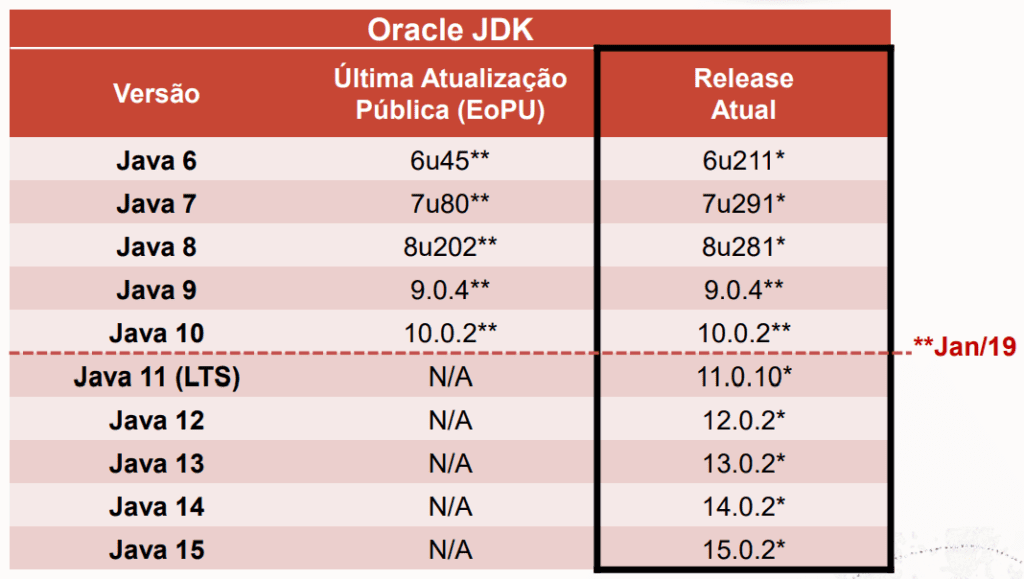
Starting with Java version 11 (more precisely the JDK 11 release), or version 8u202, Java Standard Edition is no longer available under the BCL agreement. Instead, usage rights are governed by the Oracle Technology Network (OTN) license agreement.
Here are the most important terms of the OTN license agreement, compared to the OBCL agreement:
- You can still use Java Standard Edition components (e.g., JDK, JRE, JavaFX, JRockit JDK) internally within your organization. However, under the OTN license agreement, you may only use Java Standard Edition for the purpose of developing, testing, prototyping, and demonstrating your application (software development).
- You no longer need to differentiate between general purpose and non-general purpose computers and/or servers.
- Use of commercial resources for any type of data processing, business, commercial or production purposes is not permitted under the OTN License Agreement.
- You are not permitted to distribute, provide or transfer the Java program to any third party.
- You are not allowed to remove or modify any Java programs.
As with all other Oracle products, if you wish to use the Java program for any purpose other than those expressly permitted in the OTN agreement, you must obtain a valid license that permits such use.
Java Licensing Models
Oracle sold three different commercial licenses for Java:
- Java SE Advanced
- Java SE Advanced Desktop
- Java SE Suite
These programs were sold on a Named User Plus and/or Processor metric (Java SE Advanced Desktop was licensed only on Named User Plus) where you paid for a license and a support fee. As of January 2019, this licensing model is no longer available. Instead, Oracle only makes its Java Standard Edition programs available through so-called subscriptions:
- Java SE Subscription
- Java SE Desktop Subscription
Oracle JDK vs Oracle OpenJDK
Until Java 11, you could download the JDK from Oracle and use it for production use with paid support or use in other environments for free. Starting with Java 11, Oracle introduced two different JDK builds:
- Oracle JDK (commercial) – Free as long as you don’t use it in a production environment. You’ll get updates and support included.
- Oracle OpenJDK (open source) – free in any environment, like any open source library. When it comes to getting security updates, it is less frequent, as it is made available by the Java community.
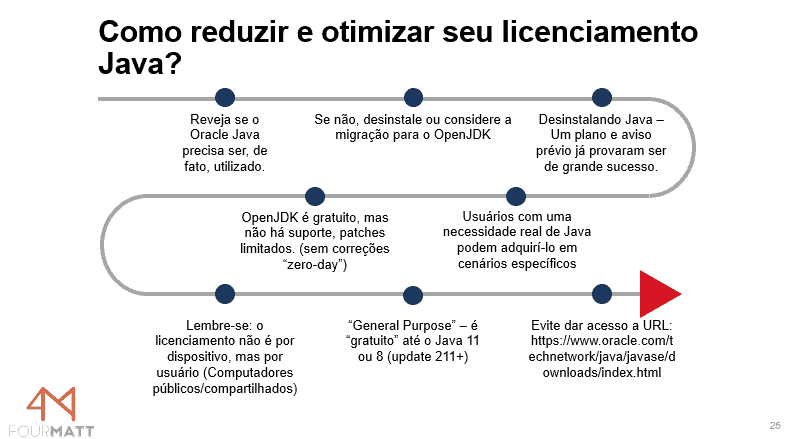
Oracle JDK and Oracle OpenJDK are the same from a functionality perspective. From a technical support perspective, there is a difference. Oracle will provide you with security patches and/or updates for Oracle JDK, while the Java community will provide you with the Oracle OpenJDK version. Many end users are considering migrating to OpenJDK instead of the paid version from Oracle. The question you should consider is how much time and effort will it take for your organization to continuously update/upgrade your OpenJDK versions?
Origins of Java
The story begins in 1991, at San Hill Road, a company affiliated with Sun (which today belongs to the company Oracle), formed by the team of engineers led by Patrick Naugthon, Sun Fellow and James Gosling. The group was starting a project called Green Project, which consisted of creating modern software technologies for consumer electronics companies. The main idea of Java was for electronic devices to communicate with each other.
Java was the first to use television set-top boxes interacting with portable devices and other consumer electronics products, it was the same way it was started in 1991, having portability to any environment and development for multiple platforms, in consumer electronics environments, since then Java has been leading the market in terms of language.
Java applications have a fundamental characteristic that allows software development without worrying about the type of system or platform that needs to be developed and prepared.
Java has been very popular among both programmers and regular users because it allows for rapid development and because it has the ability to run its source code on any system that supports the Java Virtual Machine (JVM). Other virtual machines and JDKs that can increase developer productivity, such as GraalVM Enterprise and Azul Java, are also available for use. To have the Java Virtual Machine on your system, you need to install the JRE (Java Runtime Environment).
Many websites, usually with multimedia content (or even your internet banking), require the user to install Java to function correctly.
Conclusion and Recommendations
Java Standard Edition (including JDK, JRE, JavaFX, JRockit JDK) will continue to be available free of charge as long as it is used to develop, test, prototype, and demonstrate your internally developed application(s). If you are using Java Standard Edition for any data processing, business, commercial, or production purposes, your use of Java will incur an additional cost as it must be licensed.
Alternatively, the company may decide to start using OpenJDK, or maintain the versions that are covered by the BCL contract, which is not recommended, as your organization will be left without the support and security patches made available for the product by Oracle.
4Matt can help your company optimize Java costs in the following ways:
- Analysis and categorization of the inventory report, classifying the Java that is installed on the machines (Desktops, servers and VMs) according to its version and licensing agreement
- Assessment of Oracle Java usage, checking the need for each environment and use of commercial features.
- Creating a report with assessment results
- Consulting on optimizing licensing and updating Oracle Java products
To explore the vast universe of Java platform, It is essential to understand the importance of Java Card, a technology that enables the development of applications for embedded devices. A Oracle Corporation, a leader in the market of Java technologies, offers a complete ecosystem for developers, including the Oracle JDK and the Java Runtime.
THE application development Java requires a deep understanding of execution environment, and the Oracle Corporation provides several tools to assist in this process, such as Java Management. Through Java Management, It is possible to monitor and optimize the performance of Java applications, ensuring their efficiency and security.
THE Java platform It is a versatile and robust environment, encompassing everything from... Java Card, for applications in IoT devices, up to the most diverse Java technologies to application development corporate. To explore all the features of Java platform, It is highly recommended. Create an account in Java platform. To the Create an account, The developer will have access to exclusive documentation, tutorials, and tools.
THE Oracle Corporation publishes regularly press releases with information about the latest news and updates from Java platform. Follow these press releases It is essential to stay up-to-date on market trends and innovations.
In summary, the Java platform, with the support of Oracle Corporation, continues to be a powerful tool for the application development modern and efficient. Mastering the Java technologies, to understand execution environment and use the Java Management These are essential skills for any developer who wants to stand out in the market.”
If you or your company need any of these services or want to talk a little more about Oracle Java, contact us at HERE.
Indirect Tag: artificial intelligence, artificial intelligence, artificial intelligence, artificial intelligence, artificial intelligence, artificial intelligence, artificial intelligence, artificial intelligence, artificial intelligence, artificial intelligence, artificial intelligence, artificial intelligence, artificial intelligence, artificial intelligence, artificial intelligence, artificial intelligence, artificial intelligence, artificial intelligence, artificial intelligence, artificial intelligence, artificial intelligence, artificial intelligence, artificial intelligence, artificial intelligence, artificial intelligence, artificial intelligence software ...
java language design patterns java card design patterns free shipping data types runtime environment income tax java continued write once run frontend programmers brazil ltda hello world study plan we can help build apis earn money java code java download internet explorer best practices free shipping hello world magazine luiza java technology development environments react native java ee product details java in internet explorer java development java platform java development platform virtual machine gnu general public java runtime environment runtime environment programming languages java runtime technical support oracle subscription customer reviews software developers oracle university java development kit java development kit jdk development kit end users product details java continued license optimization java software java download release cadence linux mint java development personal use latest version


